
AusCon2.0: A Radical Year Zero for a National Reboot
The States are failing administratively and financially. Decentralising into cantons could radically transform regional Australia for the better, make the nation richer than ever.

Today's 4am thinking. To contemplate a Radical Year Zero for the Australian Federation is to engage in an act of necessary intellectual hygiene, and we must begin by stripping away the sentimental veneer of our founding myths and acknowledging that our states were never the product of a grand democratic vision. They were, in reality, administrative colonies carved out by the British Crown and managed by a local elite of squatters and land bankers who viewed the machinery of government as a shield for their private interests. These nineteenth century politicians and bureaucrats used the excuse of the tyranny of distance to justify the preservation of their own jobs and relevance, creating a middle tier of governance that was always more about self preservation than the service of a unified people.
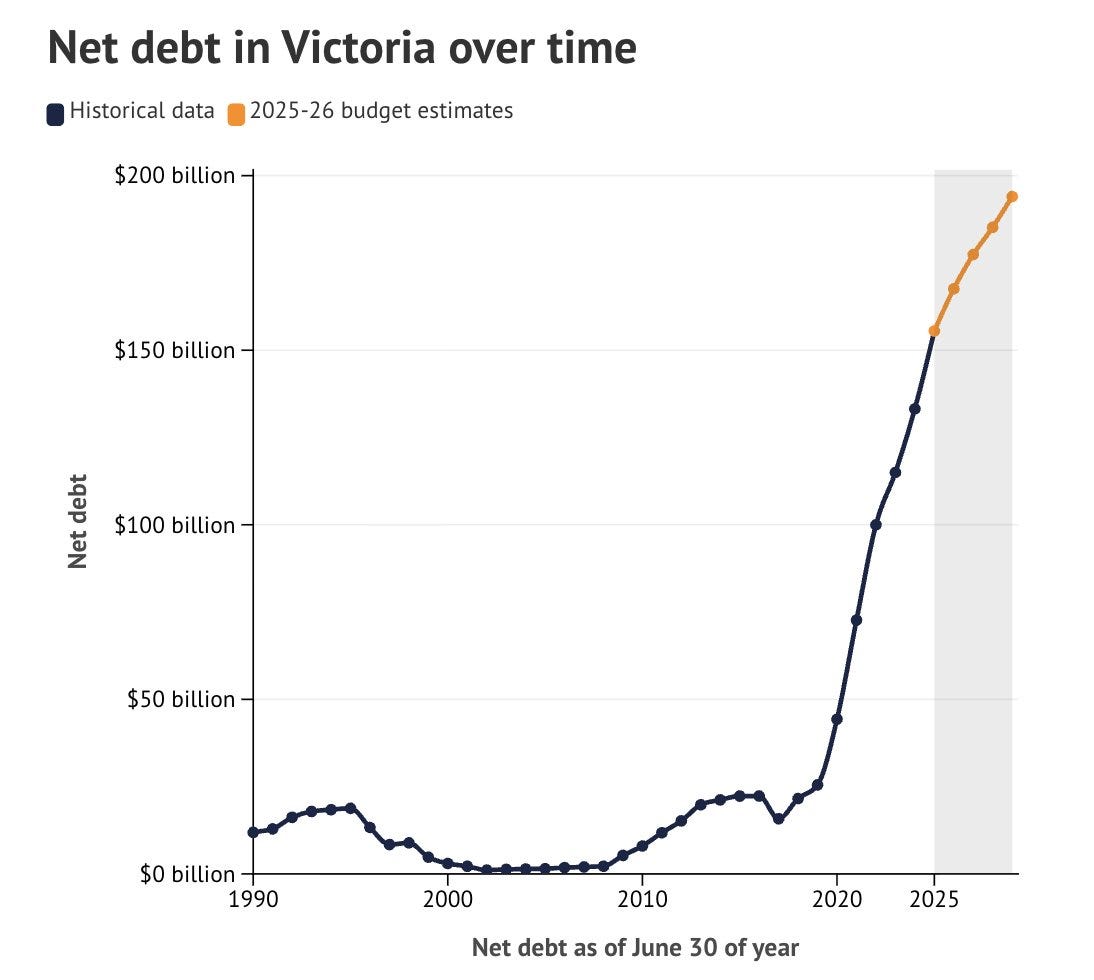
If one looks at the current fiscal trajectory, the evidence for this obsolescence is found in the soaring bars of our debt charts where the true cost of this redundant middleman is laid bare. The latest graph analysis reveals a staggering reality where total state debt is set to reach six hundred and eighty eight billion dollars by the end of the twenty twenty six financial year, with New South Wales and Victoria leading this descent into the red at over two hundred and twenty billion dollars each. When you combine this with a federal net debt approaching six hundred billion dollars, it becomes clear that we are paying a ruinous premium to maintain six different education departments and six separate health systems, as if we were still waiting for news to arrive by clipper ship. This high cost operating system is a relic of a bygone era, and it persists today only because it serves the interests of a political class that fears its own disappearance.
The physical isolation of the early settlements once required a localised authority, but that geographic barrier has been thoroughly dismantled by the relentless advance of modern technology which has solved the distance problem once and for all. By moving toward a system of local cantons and a unified national framework, we could finally align our political structure with the reality of the twenty first century and stop the haemorrhaging of public funds into colonial era bureaucracies. Australia enjoys a vast abundance of mineral wealth, yet the current state based royalty systems often result in an absurd race to the bottom where multinational corporations are permitted to play one jurisdiction against another.
A Radical Year Zero would allow us to centralise and then equalise the distribution of these royalties, ensuring that the treasures beneath our feet benefit every citizen regardless of their postcode. Under a canton model, local regions could also leverage their own specific taxes to put pressure on sustainable environmental outcomes, allowing communities to capture the wealth that is currently gifted to foreign entities while finding the benefit of their own natural resources. This transition would represent the final stage of our national evolution where the Australian people finally move beyond being residents of a colonial outpost and become the true owners of the commonwealth. It is time to retire the redundant bureaucrats and the artificial borders they defend, allowing the citizenry to finally enjoy the riches of their own land in a truly sovereign and modern nation.
To achieve the transition toward a Radical Year Zero, we must first engage in a blunt public information campaign that exposes the current Australian state as a debt sodden museum of colonial era administrative overlap. The public must be shown the ledger of their own dispossession where billions of dollars are annually incinerated on the redundant altars of six different education departments and six separate health bureaucracies. We must make it clear that while the states bicker over jurisdiction, our collective mineral wealth is being quietly siphoned off by multinationals who find it easy to navigate a fractured regulatory landscape that was originally designed only to preserve the jobs of nineteenth century squatters and land bankers. By illustrating that this duplication of services is not a safeguard of democracy but a parasite upon it, we can build the necessary momentum to reclaim the treasures that lie beneath our soil for the benefit of the actual citizens.
The migration debate must also be decentralised and placed firmly in the hands of the cantons so that we might finally align our population growth with physical and social reality. Under this new model, the authority to issue work and residency permits would shift from a distant federal bureaucracy to the local cantons who would decide their own sustainable levels based on their specific infrastructure and housing capacity. This would effectively end the era of unplanned mass immigration that serves only to inflate the property portfolios of the city based elite while placing an unbearable strain on regional services. By making immigration a local responsibility, we ensure that new arrivals are welcomed where they are actually needed and where the environment can sustain them, rather than being used as a crude tool for aggregate economic growth that leaves the average Australian poorer.
To secure the financial independence of these new regions, each canton should be empowered to establish its own public bank modeled on the successful regional systems of Europe. These institutions would be mandated to capture and reinvest local wealth within the community rather than allowing it to be whisked away to global financial centres. In regional areas, these canton banks could take the radical but necessary step of offering interest free loans for owner occupied housing, effectively stripping the predatory profit motive from the basic human need for shelter. This would not only stabilise the housing market but also foster a sense of genuine ownership and stake in the land, allowing families to build equity without being shackled to the fluctuating whims of the commercial banking sector.
The road to this constitutional rebirth would require a staged series of national referenda to ensure the public remains the ultimate architect of the change. The first vote would be a simple plebiscite to break the legal lock and ask the Australian people if they wish to abolish the states in favour of a more rational and local governance structure. Following an affirmative result, a second referendum would present specific options for the canton boundaries and the division of powers between the local and the national levels. The final stage would involve a ten year transition period where the state bureaucracies are gradually dismantled and their essential functions are absorbed by the new canton authorities. This is the only path toward a truly modern and sovereign nation where the citizenry finally enjoys the full measure of their inheritance and the dignity of a government that actually fits the geography of their lives.